I believe that one carries the shadows,
the dreams,
the fears, and the dragons
of home
under one’s skin…
–Maya Angelou
Two weeks ago, after 20 years away, I returned to Texas. Last time I was there, in fact, was to bid good-bye to my father’s mother, Ruby Jewell Johnson Moyers, aka my grandma, Mimi. (Whose childhood in Indian Territory I am saving for another book.)
My trip this time served a three-fold purpose: To attend a memorial service in east Texas for my aunt, who’d died a few months ago; to introduce my teenaged daughter to an important piece in our family history*; and to do what I call “open-air research.” Even knowing I wouldn’t have much time to stop at libraries and museums, at this point in my writing process, I felt a deep need to be where my story had taken root.
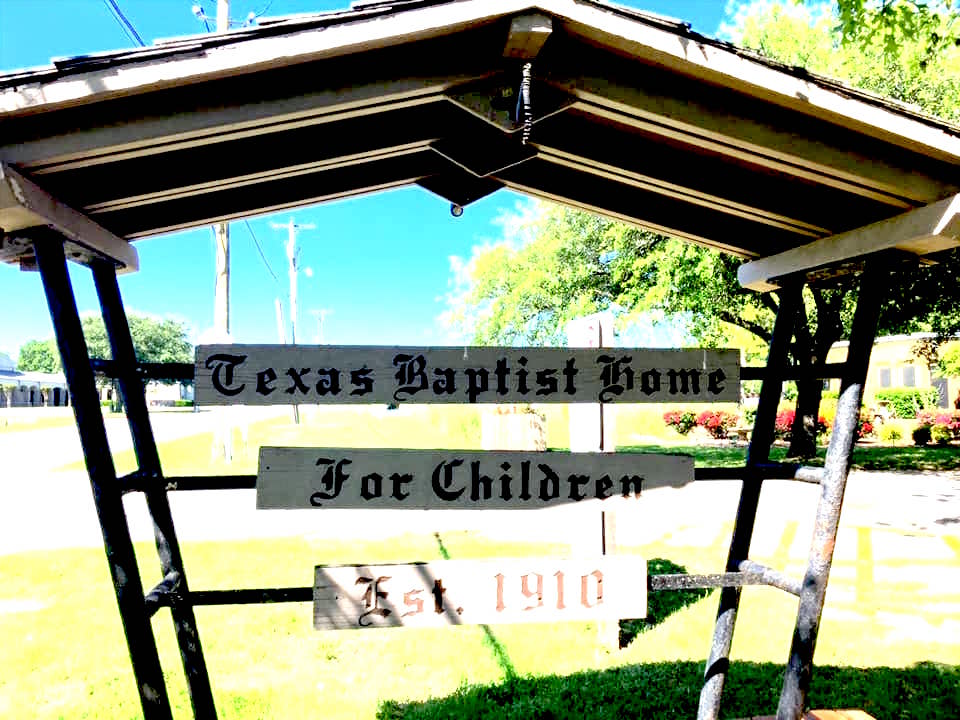
As we drove from east Texas toward Dallas one day, my daughter and I stopped in the small town of Waxahachie, where the orphanage where my grandmother and her siblings lived was located. We quickly found the Baptist Home, which still exists in some form on the same spot as the original complex, but now serves a foster care facility and adoption agency. The building where my grandmother and her three siblings were housed is no longer there, but the sidewalk that led to the front door remains.
The folks at the Home showed me some photos from that time, including the aerial shot, below, taken in the 1940s or 50’s. The big boxy building on the right side of the main complex is, I think, the original orphanage before it was torn down. And there’s that same sidewalk, leading to a memorial of the original orphanage, its founders, and benefactors.
 |
| Aerial shot of orphanage, w/ sidewalk |
 |
| Original sidewalk, today |
Looking down that pathway, I tried to imagine Eula Emma (Nana), age 11 or 12, her younger sister, Edith; brother, Larkin; and the baby of the family, Charlena, arriving at their new home in late 1919 or early 1920. (Their names, as “inmates,” appear on the 1920 census.) They’d already been through so much: The harrowing accident that left their father maimed; his disappearance after leaving to find work in Houston; the “boomerang” epidemic of Spanish influenza that struck Texas in 1919, killing their mother and leaving my grandmother, who barely survived her own illness, with weak lungs…and responsibility for her three younger siblings.
Standing there 100 years later, I imagined Eula Emma clutching the hands of her younger siblings, putting on a brave face as they walked toward the dormitory-style building that was their new home. How burdened she was by the promise she’d made to her mother before she died.
A promise that, in the end, came at a terrible cost.
After they arrived at the orphanage, there were many prospective parents who wanted to adopt baby Charlena. (In those days, adoptive parents got to “choose” their children.) No matter how well-intended, institutionalized care is no substitute for being raised by a loving family–especially where young children are concerned. Such a circumstance may have contributed to the mental health issues that plagued Charlie into adulthood–and which my grandmother felt responsible for her entire life.
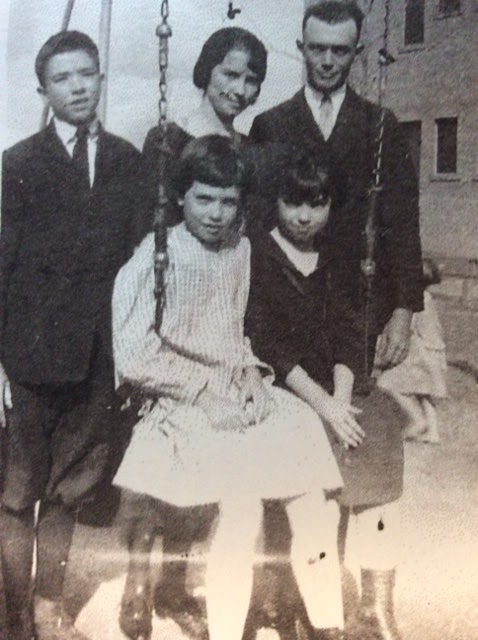 |
| My grandmother (top, center), having”aged out” of orphanage, visited her siblings often. (The young man at right is their much older half-brother.) |
It’s only in writing this novel that I’ve come to understand the possible reason for my great-grandmother’s charge: Perhaps she believed (or maybe even knew) that her long-lost husband wasn’t dead, and might yet claim his children. Turns out, she was right on some level. Papa hadn’t died after going to Houston, but remarried and fathered eight additional children. He knew full well the plight of his “first family,” but never went back to get them–never, as far as we know, even inquired about them. My grandmother found this out in her 50’s, after one of her half-siblings reached out to her. While it did not break my grandmother, it left her heart deeply scarred–a fact I witnessed firsthand as a teenager, when she came to live with us after developing dementia, and cried often for her father: Papa! Please, Papa! Where are you?
The thing about fictionalizing family history is that you can delve deeper into the might-have-beens and if-onlys. You can complete half-circles and soften jagged scars and finish waylaid journeys. Yes, you can rewrite history, and, in the act, even entertain possible answers where once there was only that wrenching question: Why?
*An interesting experience for my daughter, given she was adopted from South Korea as an infant, has journeyed to her own birthplace, and will again in the very near future.
 Suzanne Moyers