When she was about 12, my grandmother’s father, aka Papa, lost his arm to a sawmill blade. I think it was Nana herself who described to me the one detail she remembered from that day: How Papa’s coworkers burst into their house and heaved his bloody body onto their kitchen table. How the blood dripped everywhere.
No kid would forget that moment, and its description stayed with me, too, eventually becoming the inspiration for an
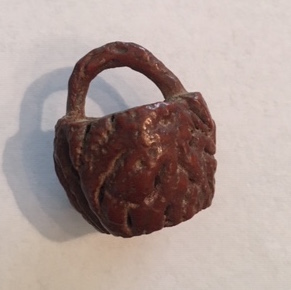 |
| Walnut shell basket, whittled by my great-grandfather, Andrew Davidson |
early scene in my book:
“Arm got caught up in the saw blade,” Dell shouted. “Doc’s right behind us.”
Leola gaped at the bright coins of blood across the floor, slid her eyes up Papa’s body, stopping at the filthy piece of fabric wrapped ‘round both his shoulders, soaked through on the left side. Dell was pressing on it now, trying to stanch the blood.
The tips of Leola’s fingers went weak and, finally, she dropped the knife and apple.
“Papa!” she cried, lunging toward him…
In my novel, it takes a full year for Papa to recover, physically and emotionally, from that trauma, and though he eventually teaches himself to do certain things one-handed–milking a cow, riding a horse, playing his French harp–his beloved hobby, whittling, seems lost to him forever.
Papa was a right good whittler once, able to carve all sorts of things from walnut shells and peach pits and branches. When he finds a beautiful piece of basswood near the creek one day, he challenges Leola to try whittling it in his stead. She remembers some techniques from watching him through the years, but isn’t having a lot of success. Though Papa tries to guide her verbally, he soon grows frustrated, wishing he could show her himself.
Leola takes it upon herself to find something to help him whittle again, something not-too-complicated she can rig up from readily-available materials. Something to take the place of the hand that would hold the object while the other hand carves. But what?
 |
| Walter Stewart, famous whittler |
Googling “how to whittle one-handed” returned some interesting ideas, especially from the field of occupational therapy, though nothing practical to Leola’s situation. I did learn about Walter Stewart, who was was born with a congenital condition that stunted his arms and legs. Mr. Stewart’s whittling skills earned him a place in a circus sideshow soon after the Civil War, though I could find few details about how he accomplished this feat.
Then, one day, I was organizing a kitchen cabinet (surefire cure for writer’s block, btw) when I came across the apple peeler we’d bought at a home goods store years ago, and which our family has used a total of, maybe, 5 times. Turns out, such devices also existed in the late 1800s, and were, in fact, considered the kitchen gadget every “modern” farm wife had to have. (Of course, in the time it took to set up the thing, practiced cooks like Leola and Mama could peel, core, and slice a dozen apples with a plain ol’ paring knife. Thus, such contraptions tended to gather dust, as ours has.)
 |
| Antique apple-peeler |
And so my Eureka moment became Leola’s, which strikes while she’s canning tomatoes with her mother one hot September afternoon. Looking up to a high shelf in their kitchen, she spots her grandmother’s old apple peeler-corer, which Mama nicknamed, The Apple Inquisitor, for it does resemble a torture device, with the spikes on one end to hold the piece of wood, and toothy gears for turning the shaft. Leola improvises a way to lock the shaft in place with a small butter knife, which can be removed easily so a different side of the piece can be worked. And, voila!, Papa’s Whittling Arm is born.
With the help of her little sisters, Leola presents the invention as a surprise for her father, who is, of course, deeply moved, not just by her ingenuity, but by the compassion behind it:
Papa smiled, pulling two chairs near the whittling and picking up his penknife again.
“Now, Rosalee, let’s see if I can’t teach you some of those techniques we were talking about the other day.” He winked at her sisters. “Mae, Karla, you watch, too, for soon enough, it’ll be your turn to try.”
And then the whittler set to work.
.
 Suzanne Moyers